Documentation Structure
Topics
- The Documentation Structure - Hierarchy
- Create Document Folder
- Display of Document Folders
- Create Plan Folder
- Copy / Move Document Folders
- Copy / Move Plan Folders
- Copy / Move Folders
- Copy / Move Subjects
- Convert Subjects and Folders
- Export Documentation Structure as Excel Report
- Visualize User Access
- Use Drag & Drop for Documents
The Documentation Structure - Hierarchy
The documentation structure follows a defined hierarchy. The top level consists of subjects , where any number of subjects can be created below a subject. Below that comes the folder level
. Below the folder are the folders, and within the folders are the documents (files). Folders for documents (doc, xls, jpg)
and CAD documents (dwg, plt)
are distinguished.
CAD documents are not stored directly in a folder but require an additional index that reflects the planning status.
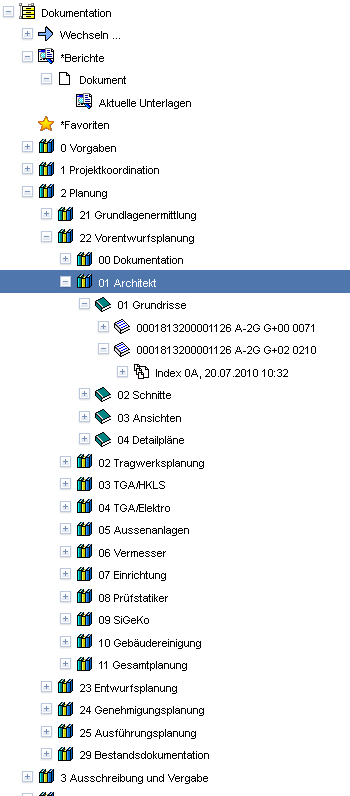
By default, empty parts of the documentation are displayed in gray and italics. This can facilitate finding documents in the documentation. Depending on the configuration, this display can be deviated from.
With specification of a category, individual symbols can be set for subjects with appropriate configuration.
Create Document Folder
Document folders are used to store documents. To create a document folder, select the action  in the desired folder.
Give the folder a name. If you select a folder type, all documents created in the folder will have the same document type by default. The editor is pre-filled but can be changed via the action .
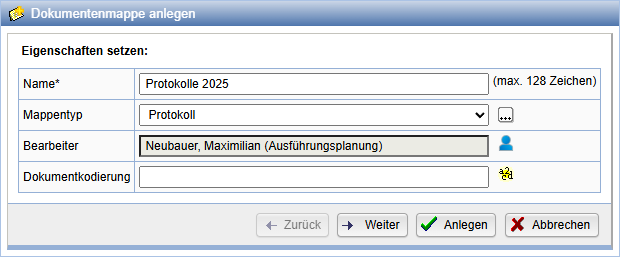
Confirm the settings by pressing Create.
You can now upload documents.
| Note: | The field Document Coding is available to you only if document coding has been set up in the project. |
Display of Document Folders
When creating documents and editing their properties, a document type (Contract, Document, Protocol, e tc.) can be assigned.
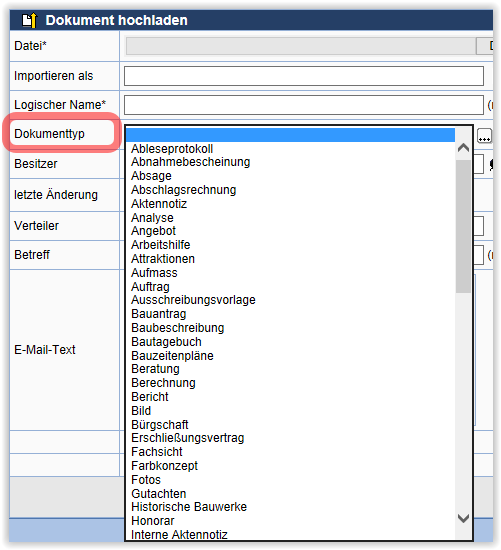
By default, all documents are divided by document types in the table. Each document type is displayed in a separate tab.
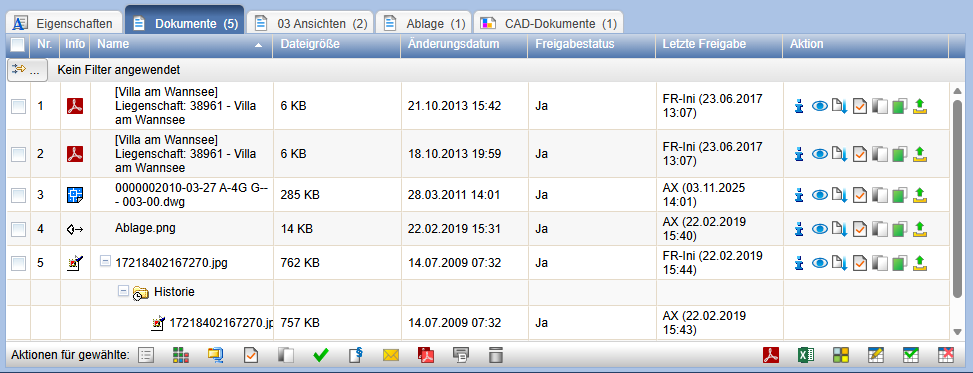
If you do not wish for this behavior, you can disable it under Personal Settings.
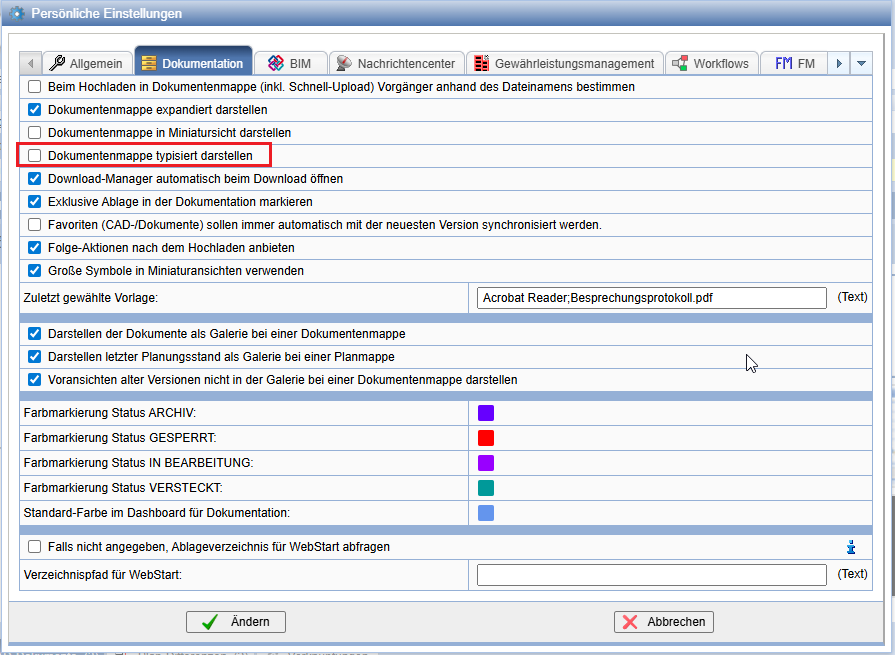
Create Plan Folder
Plan folders are used for storing CAD documents. To create a plan folder, select the action  to create plan folders in a folder.
In the following dialog, complete the coding in the field
Plan Code or enter a name if no coding is used. The processor is already pre-filled but can be changed via the
action .
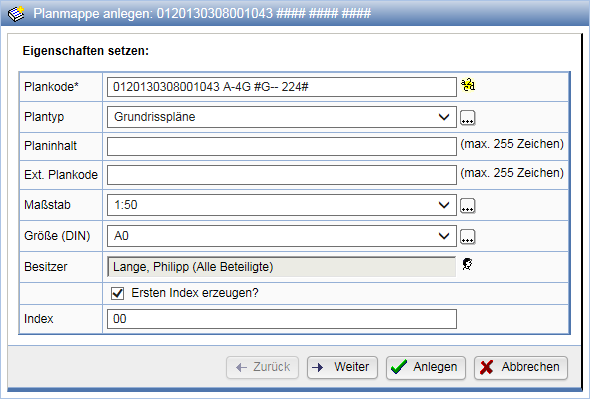
When creating the plan folder, the first index should also be created at the same time, as CAD documents can only be stored in this one.
Confirm the settings by pressing Create.
You can now upload CAD documents into the indices of the created folder.
Copy / Move Document Folders
To copy or move one or more document folders, first place them into the clipboard via the action .
Now go to the target folder and select the action , to paste the document folder from the clipboard.
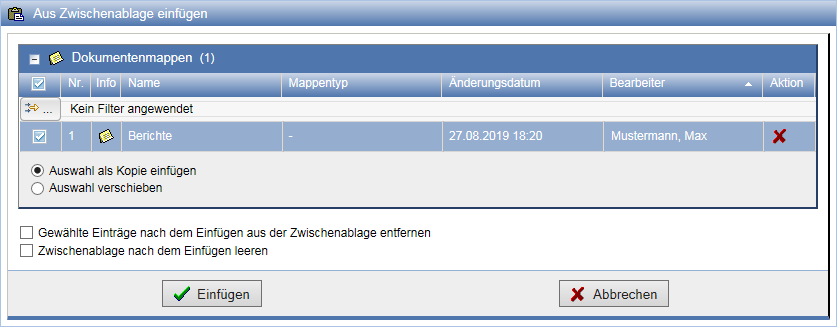
Select whether the folders should be copied or moved and press Insert.
When Copying document folders, you now select whether the contained documents together with the folders should also be copied. If only a single document folder is copied, you can additionally specify a new name for it. Furthermore, access rights and groups from the original can optionally be taken over. To copy, you must have write permissions at the target location.
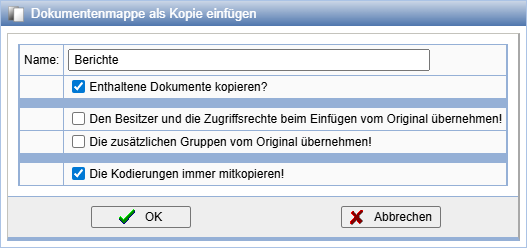
When Moving the folder is removed from the source location and inserted with its content at the target location. To move the folder, you must have delete permissions at the source location and write permissions at the target location.
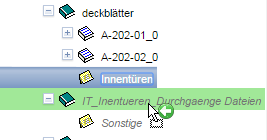
Document folders can be moved via drag-and-drop in the documentation tree. To do this, drag the document folder into the target folder.
To copy a document folder, hold down the CTRL key while moving.
Copy / Move Plan Folders
To copy or move one or more plan folders,
first place them into the clipboard via the action .
Now go to the target folder and select the action to paste the plan folder from the clipboard.
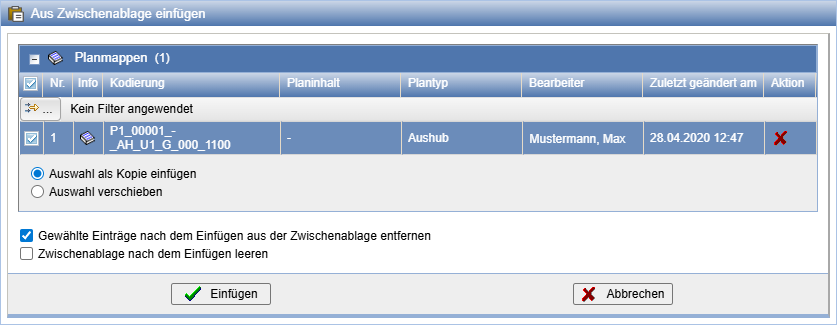
Select whether the folders should be copied or moved and press Insert.
When Copying one or more plan folders, only the respective last indices are taken over and named according to the default setting for new indices. In the copied index, the source index is entered as predecessor; thus, tracing is possible. To copy, you must have write permissions at the target location.
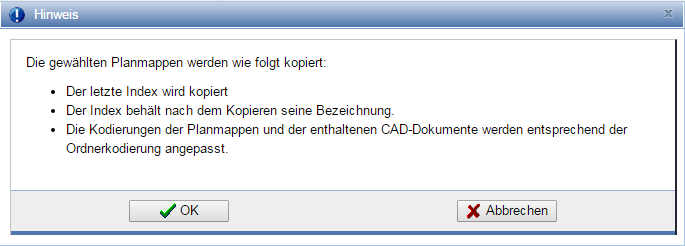
When Moving the folder is removed from the source location and inserted with its content at the target location. To move the folder, you must have delete permissions at the source location and write permissions at the target location.
If a different encoding is specified at the target folder, you will be prompted at the end to adjust the encoding accordingly.
Copy / Move Folders
To insert one or more folders at a different location, first create them via the action to the clipboard.
Go now to the target folder and select the action , to insert the folder from the clipboard
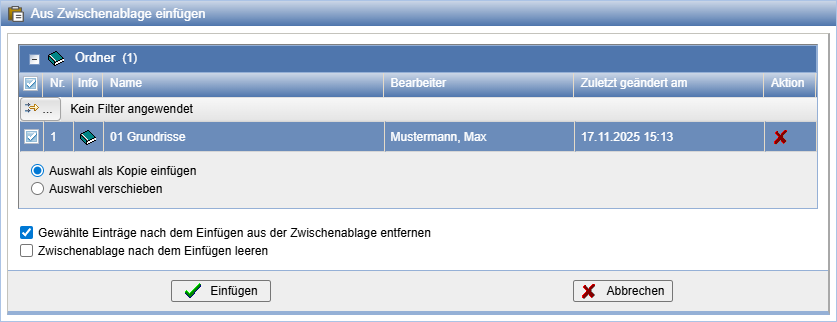
During Move the folder is removed from the source location and inserted with its contents at the destination. To move folders, you must have delete permissions at the source location and write permissions at the destination location.
During Copy of folders, you may need to decide whether the contained documents should be copied along.
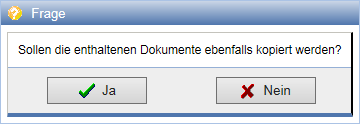
Special Copy / Move
To insert one or more subjects at a different location, first move them via the action to the clipboard.
Go now to the target folder and select the action , to insert the sheet from the clipboard.
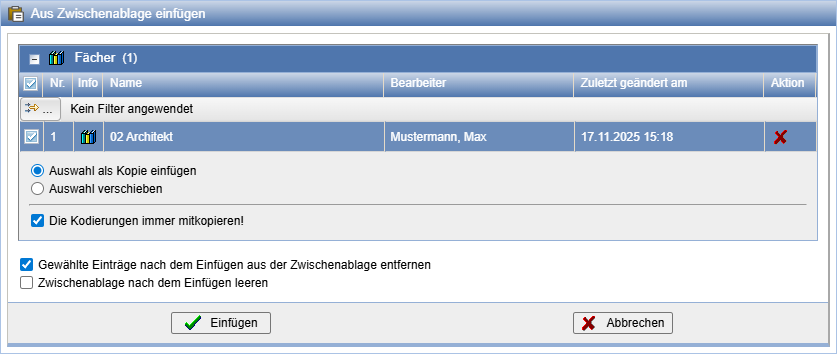
During Move, the subject is removed at the source location and inserted with its content at the target location. To move subjects, you must have delete permissions at the source location and write permissions at the target location.
During Copy of folders, you may need to decide whether the contained documents should be copied. With the selected option "Always copy the encoding!". If necessary, the encodings of the subjects and the contained objects are copied. Otherwise, if necessary, the encoding of the new location is taken over.
Convert Folders and Files
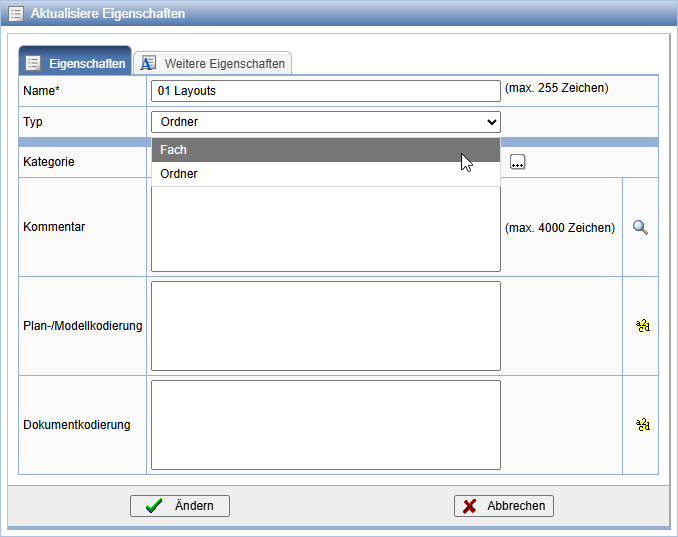
About the Type in the area Update Properties, you have the option to convert existing subjects into folders retroactively. Similarly, folders can be converted back into subjects. However, the condition for both actions is that the subjects or folders must be empty.
Documentation structure as Excel report export
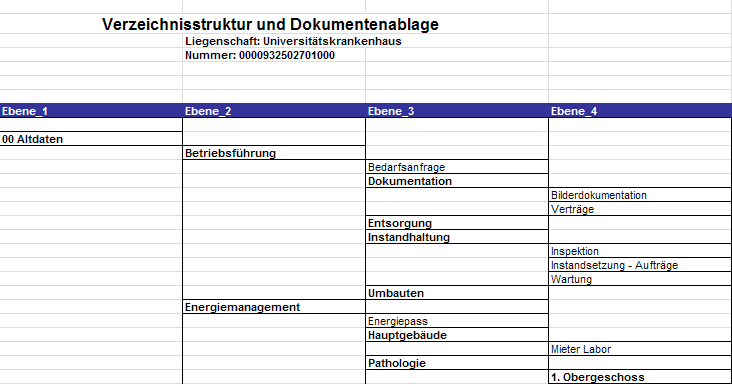
The documentation structure can be displayed clearly as an Excel table. In addition to the fields, folders, and possibly maps, information regarding the corresponding read and write permissions, encoding, and owner is listed. Only the parts for which you have read access are listed.
To display the documentation structure as an Excel table, press in the action bar of the documentation or the desired field  .
.
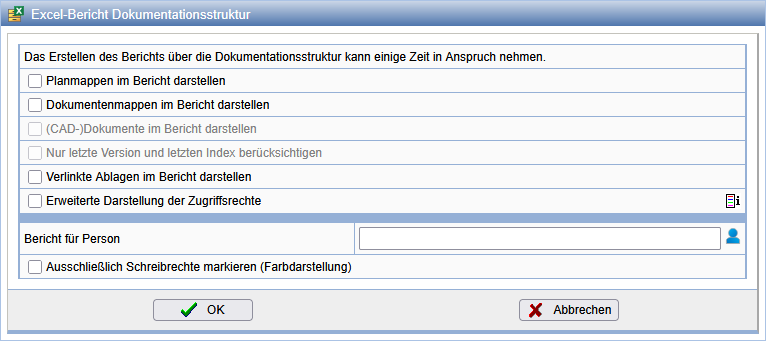
Optionally, the plan folders and document folders located in folders can be printed. To do this, select the corresponding option.
An Excel table with the documentation structure is generated, which can be displayed directly or downloaded depending on the browser configuration.
Visualize person access
Access rights to the documentation structure can be visualized for any project members.
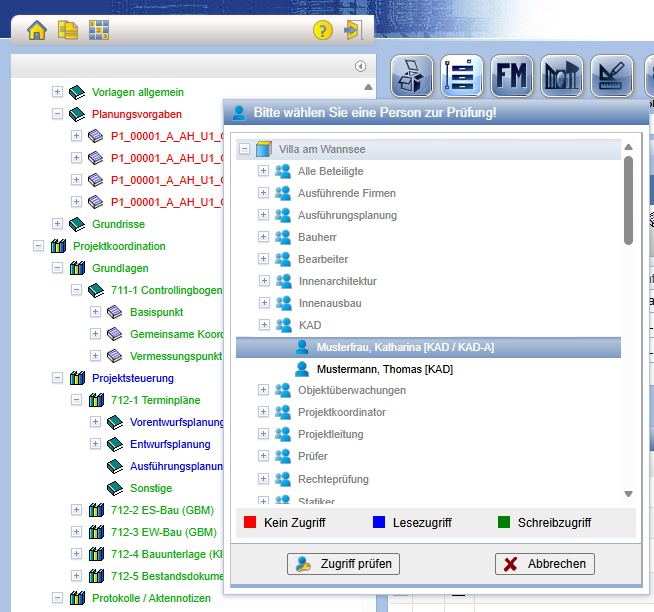
In this case, the respective write or read rights are displayed in color within the documentation structure.
To do this, select the action  in the action bar of the main node of the documentation.
Thereupon, a dialog opens with the group structure of the respective project.
Select the member whose access rights you want to review and confirm with Check Access. The documentation structure is colored according to the permissions of the respective user.
in the action bar of the main node of the documentation.
Thereupon, a dialog opens with the group structure of the respective project.
Select the member whose access rights you want to review and confirm with Check Access. The documentation structure is colored according to the permissions of the respective user.
Use of Drag & Drop for Documents
Documents can be via the Clipboard copied, shifted and referenced. Additionally, documents can also be handled via drag & drop. For example, these can be used in certain dialogs to be inserted in the appendix. To sort documents, they can be moved from one document folder to another using drag & drop. If the Ctrl-Hold key pressed, the selected documents are copied; if additionally Switch-key held down, these are then referenced instead.